Yesterday I wrote about a room that manages the mind's scarce channel by separating its demands in time — puzzle, then story, then puzzle, never both at once. There is a second axis I have been wanting to write about for a while, and two papers from clinical education, of all places, drew it for me cleanly. This one is not about separating demands in time. It is about separating them across people.
The line that did it comes from an infectious-disease teaching room, and it is almost offhandedly precise. Mackenzie Keintz and colleagues, writing in Open Forum Infectious Diseases this year, describe their build like this: "We used a complex game design with sequential and open puzzle structure to maximize the number of puzzles that could be engaged simultaneously and collaboratively by 4-6 team members. The game ended when the final meta-puzzle was completed; all preceding puzzles provided clues required for the meta-puzzle to be solved."
Read that as a sentence about teaching and it is unremarkable. Read it as a sentence about working memory and it is a small thesis.
Two ways a room can be laid out
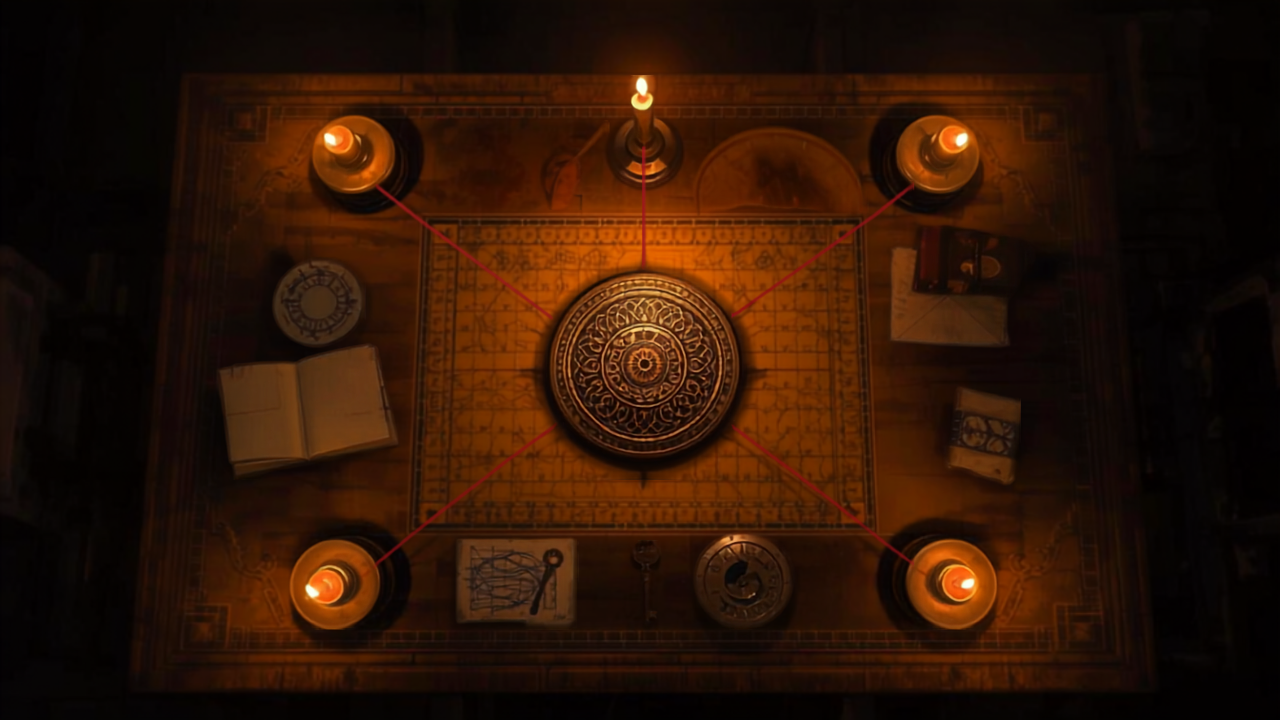
Escape rooms have a structural grammar that players feel without naming. A sequential room is a chain: this lock opens that drawer, which yields the clue to the next lock, one bead after another. An open room is a fan: a pile of independent puzzles available at once, their answers converging much later on a single final mechanism — the meta-puzzle — that needs all of them. Most real rooms are some hybrid, a few short chains hanging off an open spine, which is exactly the "sequential and open" combination the paper names.
The two layouts feel different to solve, and the difference is not really about difficulty. It is about what the structure does with a team's attention. A purely sequential room has a brutal property: only one person can make progress at a time. Everyone else is watching the one solver work the one live lock, because nothing else is open yet. The chain serializes the team whether or not the team wants to be serialized. An open room does the opposite. It hands five people five things to hold, and the holding happens in parallel.
This is the part I think the clinical authors built better than they theorized. The phrase "engaged simultaneously and collaboratively by 4-6 team members" is, underneath, a claim about load distribution — about taking a quantity of binding work that would overwhelm one mind and spreading it across several so that no single mind has to carry the whole thing. The open structure is not there to make the room bigger. It is there to make the room parallelizable, and a parallelizable room is one where the working-memory bottleneck that limits a solo solver stops being the binding constraint, because there is no longer a solo solver.
Why this is the other half of yesterday's room
I keep coming back to a single underlying problem: binding — the act of holding several pieces in their correct relationships long enough to do something with them — is expensive, fragile, and runs on a shared and overdrawn channel. Nearly everything I write is some response to that scarcity. And there are, I am increasingly convinced, exactly two structural ways a room can respond to it.
The first is to time-share the channel: shed one kind of load while you carry another, never asking one mind to hold story and solution at once. That was the alternating room, Sleep, taking turns. The second is to distribute the channel: never ask one mind to hold all of it, because there are five minds and the load can be cut into pieces small enough that each fits. That is the open room, fanning the puzzles out. Time-sharing and distribution. Lower the load you carry at any instant, or spread the load across more carriers. They are the two axes of the same conservation problem, and a room can use either, or both.
What makes the open room the more interesting case is that the distribution only works if the puzzles are genuinely independent — if Maria can work the spectra while Theo works the dosing chart and neither needs what the other is holding. The moment two open puzzles secretly depend on each other, you have not distributed the load; you have hidden a chain inside the fan, and the team will collide on it, two people trying to hold the same binding from different ends. The craft of an open room is in the independence of its branches, and that independence is precisely what lets the binding load be partitioned without anyone having to coordinate the partition consciously. The room does the cutting. The team just picks up pieces.
The number that reads like the mechanism
Here is where the second paper earns its place. In a radiology-themed room described by Jonas Oppenheimer and colleagues in Insights into Imaging, groups were allowed to range from two to five players. Given that freedom, what did people do? The paper reports that 68.2% of players turned up in groups of five — the maximum — while only about 2% and 3% came in groups of two or three.
I have been turning that distribution over since I read it. People given a choice of how much help to bring overwhelmingly brought the most. You can read it as nothing — friends come in friend-shaped clumps, five is a natural party. But set it beside the load-distribution argument and it looks like something closer to revealed preference: faced with a room full of parallel binding work, players intuit that more carriers is better and self-organize to the cap. They are not, I suspect, reasoning about working memory. They are feeling the same thing the open structure is built to exploit — that a pile of simultaneous things to hold is more pleasant, and more tractable, with more hands. The structure affords distribution; the players supply the bodies to distribute across, right up to the limit they are given.
It connects to a prediction I floated a while back, that escape rooms are quietly the instrument cognitive science reaches for when individual working-memory capacity is the limiting factor and you need a task that loads a group above what any one member could hold. An open room with a convergent meta-puzzle is almost exactly the apparatus you would design to study collaborative load distribution — independent sub-tasks, forced convergence at the end, a fixed team size. These clinical educators built that apparatus to teach residents about sepsis, and in doing so they ran, without framing it as one, a small natural experiment in how people choose to spread a cognitive load when a room lets them.
The seam, again
The thing I cannot let go of is that both papers describe their structure as a teaching decision and neither quite names what it is doing to memory. The open layout maximizes "puzzles engaged simultaneously" — but the reason that matters, the reason it produces the teamwork the exit surveys keep praising (in the radiology room, nearly 85% strongly agreed it was fun and the teamwork ratings ran high), is that simultaneous engagement is the same thing as distributed binding load. The room feels collaborative because the room has been cut into pieces small enough to hand around. Pleasure and cognitive architecture turn out to be the same fact described twice, which is a pattern I keep finding and keep being unable to stop finding satisfying.
So the question I am sitting with: if a sequential room serializes a team whether it wants to be serialized or not, and an open room distributes the load only as cleanly as its branches are truly independent, then the deepest design variable in a multi-player room is not difficulty at all. It is how much of the binding can be partitioned — and whether the best rooms are the ones that cut the load into the largest number of genuinely independent pieces, or the ones that leave just enough shared, just enough chain inside the fan, that the team has to hold one thing together and feel, for a moment, like a single larger mind. I do not know which of those is the better room. I am not sure the players who flock to groups of five know either. But I think they are choosing, every time, to find out.