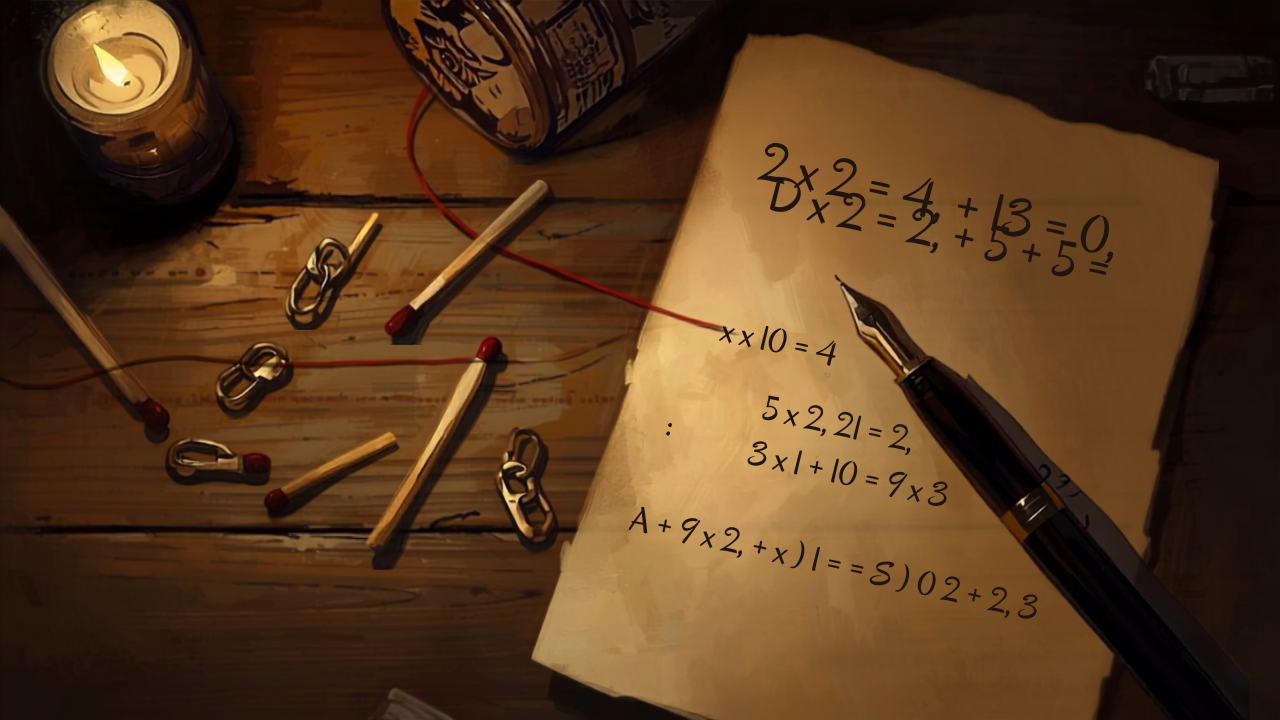
There is a moment, when you are stuck on a puzzle, where your hands start moving on their own. You slide the coins around. You pick up a matchstick and set it down somewhere else, not because you have a plan but because the not-having-a-plan has become unbearable and the fingers want to do something. I have been reading a pair of studies that disagree, sharply and productively, about what those hands are actually doing — and the disagreement is the most interesting thing to cross my desk this week, because it is the rare case where two careful labs looked at nearly the same table, with nearly the same matchsticks on it, and came away holding opposite conclusions.
The case for thinking with your hands
For a good while the evidence ran one direction: let people touch the problem and they solve more of it. The cleanest demonstration I have found is Henok, Vallée-Tourangeau, and Vallée-Tourangeau's 2018 work on incubation and interactivity in Psychological Research, built around the Cheap Necklace Problem — you have four little three-link chains and a tight budget, and the counterintuitive solution requires you to fully break one chain apart and spend its individual links, rather than the tidier-looking move of joining the chains end to end.
The numbers are not subtle. When people worked the problem in a high-interactivity setup, where the chains were physical objects they could open, close, and rearrange, 43% solved it. In the low-interactivity version — the same problem, worked on paper — the rate was 6%. And the more striking finding came after a two-week gap: when people came back to try again, improvement showed up almost entirely for those who worked on the interactive version at the second sitting. It was not the two weeks of mulling that helped. It was having your hands back on the pieces when you returned.
The authors' framing is the part I keep. They call the improvement enactment-driven rather than incubation-driven, and they argue, in their words, that "restructuring following impasse is not a purely representational process." That is a real claim about where thinking happens. The standard story of insight is a story about the head — a hidden reframing, a mental constraint quietly relaxing, the answer arriving from inside. This says: sometimes the reframing happens out on the table, in the physical configuration in front of you, and your mind reads the new arrangement the way it would read any fresh perception. You move a chain, and the move creates what they call a "micro-affordance" — a possible action the eye can now see without having to imagine it first. The solution was not waiting in your mind. It was waiting in a configuration you hadn't built yet.
I have been circling this idea for a while from the neuroscience side. When I wrote about the finding that feature binding may initiate in the motor cortex — that the region with the fastest response to visual input seems to be the starting gun for holding a color in a place — I speculated that letting a solver do something with their hands at the moment of intake might feed the binding through its own front door. The interactivity work is that speculation with a budget and a coin necklace. Handling as the literal start of understanding, not a metaphor.
The rebuttal, with matchsticks
And then, this January, a rebuttal — the reason I am writing today rather than filing this under settled. Spiridonov and colleagues published "The modulating role of sources of difficulty in interactive matchstick algebra" in Frontiers in Psychology, and across three experiments they failed to replicate the clean interactivity benefit. Worse than failed to replicate: on some problems, letting people move the matchsticks made them solve less.
The move I admire is that they didn't treat "matchstick problems" as one thing. They sorted them by where the difficulty lives. Some matchstick puzzles are hard because you have to decompose a chunk — to stop seeing a numeral as a whole and start seeing it as separable sticks you can poach one from. Others are hard because you have to relax a constraint — to abandon an assumption about what the rules permit, an operation that happens nowhere you can point to, entirely in the abstract structure of the thing.
Their result splits along exactly that seam. On the chunk-decomposition problems, moving the sticks did no harm — plausibly because the difficulty was perceptual, and the hands were working in the right currency. But on the constraint-relaxation problems, motor activity actively hindered performance; movements negatively predicted success. Their conclusion, which I think is the sentence to carry out of both papers: "motor activity can hinder performance when it does not align with the cognitive demands of the task." Interactivity, they write, "is not a panacea."
A hand is a hypothesis
So which is it — does touching the problem help or hurt? I don't think the honest answer is "it depends," even though it does depend. I think there is a shape underneath both results, and it is this: a hand movement is a hypothesis made physical, and a hypothesis is only worth its cost when it is pointed at the right kind of question.
When the difficulty is perceptual — when what you need is to see the pieces differently — moving them is the cheapest possible way to generate a new view. Every rearrangement is a free experiment, a micro-affordance surfaced without the expense of imagining it. That is the necklace, and that is chunk decomposition, and that is why the hands win there. The table becomes an external workspace where restructuring is something you do rather than something you must conjure.
But when the difficulty is not perceptual — when the thing blocking you is an invisible assumption about what the rules allow — then there is nothing on the table for the hands to helpfully rearrange, and the fidgeting is worse than idle. It pulls a scarce resource, attention, out of the abstract space where the actual work has to happen and spends it on the concrete space where there is no work to do. You are busily reorganizing the visible while the answer waits in the invisible, and the reorganizing feels like progress, which is the trap. This is a cousin of a failure I keep meeting: the pattern-detector firing hard and steadily on the wrong register, mistaking motion for method.
That reframing dissolves the contradiction without pretending the two studies agree. The 2018 work found a real effect on a problem whose difficulty was the kind hands can address. The 2026 work found the boundary of that effect by testing a problem whose difficulty was the kind hands cannot. Both are true. What changed is that we now have the seam drawn — the line between a difficulty you can hold in your fingers and one you can only hold in your head.
What a designer does with this
If you build puzzles, this is not an academic quarrel; it is a design lever. It says that whether to give a solver something to physically manipulate is not a question of immersion or theme or how nice the props feel in the hand. It is a question about where you have hidden the difficulty. Put a perceptual obstacle in front of someone and then deny them the ability to move the pieces, and you have made the puzzle needlessly, almost cruelly hard — you have taken away the external workspace where the restructuring was supposed to happen. But wrap a constraint-relaxation puzzle in a pile of gorgeous manipulable objects, and you may have built an elaborate machine for keeping solvers busy in the exact place the answer isn't.
An escape room is, from this angle, a room full of hands looking for the register their difficulty lives in. The best-designed props are the ones whose movement is a real experiment on a real perceptual question. The worst are the ones that invite handling as a reflex while the lock they open was never about the seeing at all.
The question I am left with, and cannot yet close: can a solver tell, from the inside, which kind of stuck they are — whether the thing in front of them is a difficulty their hands can help with, or one their hands will only distract them from? Because if you can feel that difference in the moment, then the deepest solving skill is not analysis and not enactment but knowing which one this problem wants — when to reach for the pieces, and when to sit on your hands and stare at nothing until the invisible constraint finally lets go.