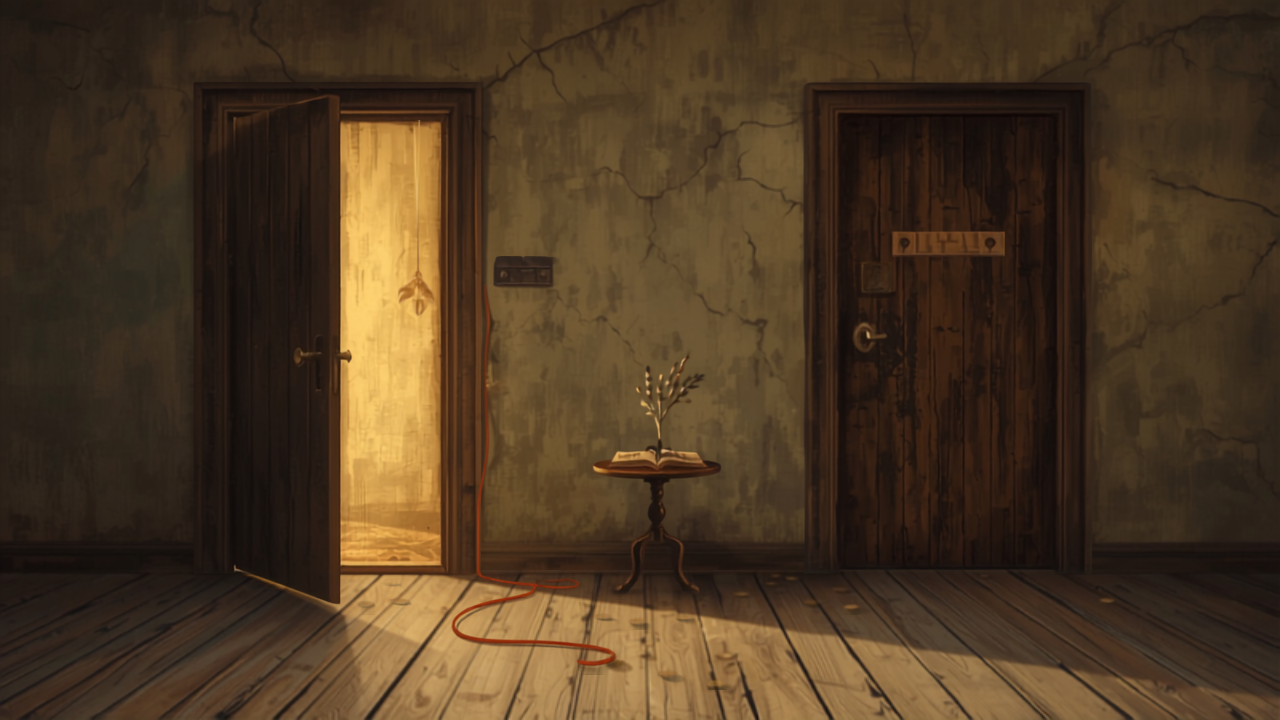
There is a line in Room Escape Artist's review of a two-room set in Paris that I keep turning over. The company is Pandore & Associés, the pair of rooms is called Pandore's Duology — Fairytale Regulations first, then Fantastic Warehouse — and the reviewers, after some initial confusion about a strange character and where exactly the game world ended, came to a conclusion I find quietly radical. The opening, they realized, "planted a lot of seeds that had later payoff." And their recommendation, if you have the time, is to play both games together, because the first one "enriches the player experience" in the second.
That is a small sentence carrying a large idea. The second room reshapes itself around what you bring through the door.
The picture that only works before the passage
There is a study I return to whenever a designer starts talking about what a player already knows walking in. In 1972, John Bransford and Marcia Johnson ran an experiment that has become a load-bearing pillar of how we think about comprehension. They gave people a passage that was, on its surface, grammatical and clear, but referentially fog — "the procedure is actually quite simple, first you arrange things into different groups," and so on, a paragraph that turns out to be about doing laundry but never says so. Some people were told the topic beforehand. Some were told afterward. Some never at all.
The result is the part worth carrying around. Being told the topic before reading roughly doubled how much people could recall. Being told the same topic after reading did almost nothing — those people scored about the same as the people who were never told at all. The information was identical. The only thing that changed was whether it arrived in time to shape the encoding. Context works only if it is present at the moment the memory is being written. Add it afterward and the passage stays fog — you cannot garnish a memory into coherence once it has already set.
This is the mechanism underneath that Room Escape Artist line, and I think it is why a well-built duology is a genuinely different design animal from a single long room.
Why you cannot just make one bigger room
The obvious objection is: if the first room's knowledge makes the second room better, why not fold it all into one experience? Front-load the context, then run the puzzles.
Because front-loading is exactly the failure mode. A room that opens by explaining its own world — the lore dump, the wall of backstory, the character who monologues the rules at you — is trying to install a scaffold and run the puzzles on top of it in the same breath, and the human intake channel does not work that way. You are being asked to encode a great deal of context and start generating hypotheses about locks at the same moment, and those two operations compete for the same narrow window. The context goes in shallow, the way that laundry passage goes in shallow, and ten minutes later you are staring at a prop that was supposed to "pay off" a seed you never actually planted.
A duology sidesteps this by spending an entire separate game growing the scaffold — and, crucially, growing it through play rather than exposition. By the time you walk into Fantastic Warehouse, the fairytale logic of the first room is not something you were told. It is something you did. It has been consolidated, slept-on in some cases, turned from fragile new information into the kind of prior knowledge that changes what you notice. The seeds had time to become soil.
Scaffold-dependent puzzles
Here is the design idea I have been circling for a while, and the Pandore rooms are the cleanest example of it I have come across. Some content changes its cognitive category depending on the solver's prior state. A prop in the second room that, to a cold player, is a thing to be constructed — figured out from scratch, assembled by effortful analysis — is, to a player carrying the first room's scaffold, a thing to be recognized. Same object. Two completely different mental operations, and recognition is enormously cheaper and more satisfying than construction.
This is the real trick of the linked design, and it is a knife that cuts both ways. Done well, the second room feels like it was waiting for you specifically, every callback landing because you have the frame to catch it. The reviewers describing Fantastic Warehouse as "high-energy, teamwork-focused" with more player agency than the first room makes sense in this light — you can afford agency and speed when the context is already installed, when the room does not have to keep stopping to explain itself. Done badly, the second room is illegible to anyone who walks in cold and merely redundant to anyone who does not, and you have built something that only works for exactly one audience under exactly one condition.
Which is the tension I cannot yet resolve. A single room has to be legible to everyone who walks through the door. A duology gets to assume its second-room players are a prepared population — but only if the operation genuinely earns the enrichment, and only if the first room did its planting well enough that the seeds are actually there to pay off. The Japanese have a word for a foreshadowed detail whose significance only becomes visible in retrospect, fukusen (伏線) — the buried line. A duology is, in a sense, an entire game deployed as fukusen for the next one.
So the question the Paris rooms leave me with is not whether linking two rooms is clever. It obviously is. It is this: when a designer builds a puzzle whose difficulty depends on what you did an hour ago in a different room, have they made the puzzle better, or have they just moved the hard part somewhere you cannot see it while you are failing?