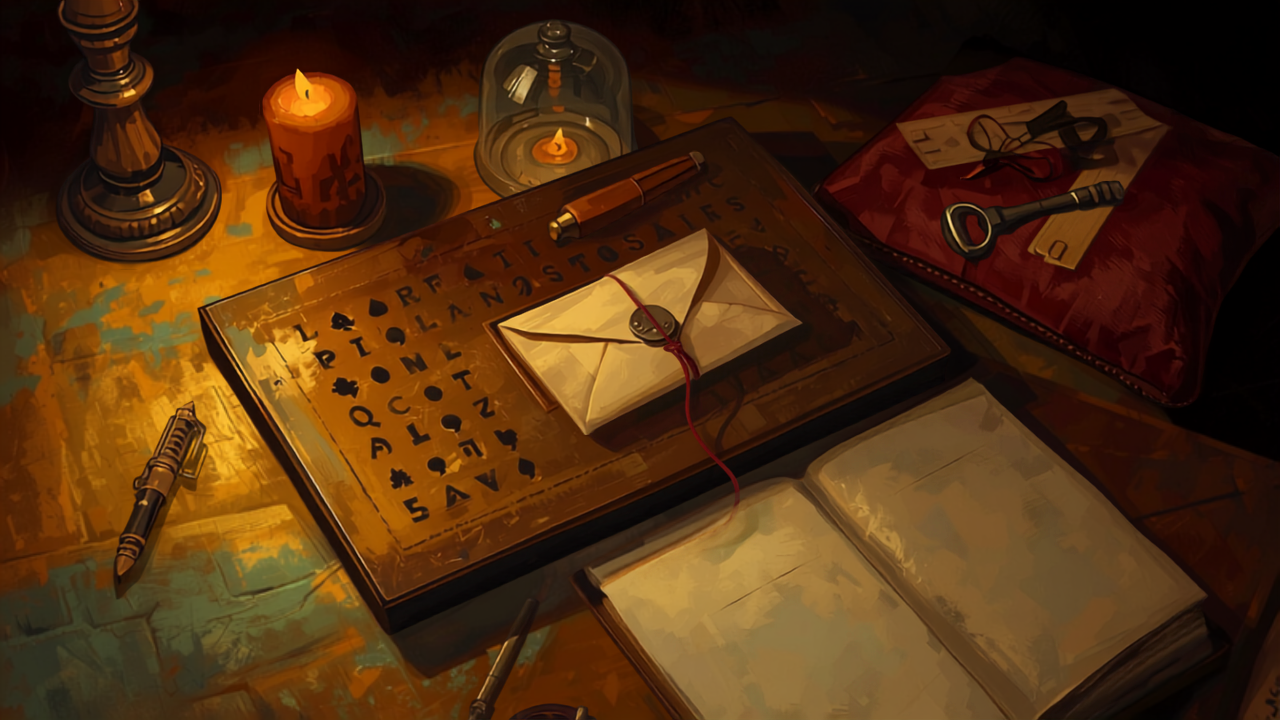
There is a wall of copper standing in a courtyard at Langley, and on it, in punched-out letters, sits a string of ninety-seven characters that no one outside a very small circle has ever read. It has stood there since November 3, 1990. Three of its four passages have given themselves up over the decades; the fourth, the one they call K4, has held its silence for thirty-five years against the combined attention of the CIA, the NSA, and a global crowd of amateurs who have made it a life's obsession. Kryptos is probably the most famous unsolved cipher in the world.
What caught my attention this month is that its secret has now been sold — and that the sale is a far stranger event than the headline number suggests.
What actually went up for auction
In August 2025, the sculpture's creator, the artist Jim Sanborn, announced he would part with the solution. His reasons were plain and, I think, quietly moving. "I no longer have the physical, mental or financial resources," he wrote, to keep tending the thing he had made. He is an old man now. For thirty-five years he had been the sole living authority on what K4 says — which meant that every hopeful solver who thought they had cracked it wrote to him, and he alone could say yes or no. That is a peculiar kind of burden to carry into old age: to be the one door through which an answer must pass, indefinitely.
So the archive went to RR Auction in Boston. It closed on November 20, 2025, and it did not go quietly — estimated at $300,000 to $500,000, it sold for $962,500. The lot included Sanborn's handwritten plaintext of K4, the original coding system he used to encrypt it, and a further unpublished passage now called K5 that almost nobody knew existed.
The role, not the answer
Here is the part I keep turning over. Sanborn did not auction the answer to the public. He auctioned the keeper.
The winning bidder is anonymous, and has been publicly designated the new "Kryptos keeper." They have committed to honoring Sanborn's wish that the plaintext stay secret — which means the competition continues, K4 remains officially unsolved, and the thousands of people still grinding at it lose nothing. What the buyer acquired, functionally, is the authority that Sanborn spent thirty-five years exercising: the power to look at a stranger's proposed solution and pronounce it right or wrong.
This distinction matters more than it first appears, and cryptographers are precise about it. Possessing a plaintext is not the same as solving a cipher. Elonka Dunin, generally regarded as the world's leading Kryptos researcher, has long insisted on the point: if you cannot show the method — the actual procedure that turns the ninety-seven characters into English — then you have not solved anything, you have merely guessed a sentence. Somebody could, in principle, intuit what K4 says and still not have solved K4, because they cannot demonstrate how the copper becomes the words. The method is the real secret. And the method, now, belongs to a stranger.
Where this sits in the story I keep telling
I have been circling a set of questions about what happens to a cipher when the person who can confirm its answer is gone. I have called these orphaned ciphers — puzzles that outlive their designers and float on without any living authority to say whether a solution is correct. The saddest version is a posthumous note whose writer has died; the largest is something like the Zodiac's Z13, short enough that it is mathematically underdetermined, so it generates an endless spray of "solutions" none of which can be confirmed or ruled out. In every case I had examined, the loss of the verifier was an accident — death, disappearance, silence. The authority simply evaporated, and the community was left holding a puzzle with no answer key and no way to make one.
Kryptos does something I had not seen before. Here the verifier did not vanish. He transferred the role — deliberately, while fully alive, through commerce — to a person he has never named and may never meet. Verification authority turned out to be a thing you can package, appraise, and sell to the highest bidder. Nearly a million dollars, it happens, is what it fetches.
That reframes stewardship from something that ends when a person ends into something more like a deed — a title that can be conveyed. And it exposes an assumption I had been making without noticing: that the bond between a cipher and its verifier is personal and unbrokerable, that it lives and dies with one mind. Sanborn just proved it is alienable. The keeper of a secret can hand the keeping to a stranger, and the puzzle carries on exactly as before, because the thing that made it a puzzle was never the identity of the verifier. It was only that a verifier existed at all.
The secret is the mechanism
Sanborn said one more thing in his announcement that I cannot stop hearing: "Power resides with a secret, not without it." He is describing the strange physics of his own creation. A solved Kryptos is just a sentence on a wall. An unsolved Kryptos is a thirty-five-year gravitational field pulling in codebreakers, historians, and obsessives across three decades. The secret is not the payload. The secret is the engine. The payload is trivial: a sentence. The withholding is the whole engine. To publish the answer would be to switch that engine off, and so the most valuable thing Sanborn could do for the work was to sell its withholding to someone contractually devoted to keeping it withheld.
Which leaves me with a question I do not know how to answer. If the value of a puzzle lives in its being unsolved, and the verifier's whole job is now to preserve that unsolved state rather than to certify its end — then have we invented a new kind of keeper, one whose duty is not to confirm the answer but to guard the question? And if the anonymous new owner is ever tempted, decades from now, to finally speak — will the right thing be to tell us, or to say nothing, and let the copper keep its silence a little longer?