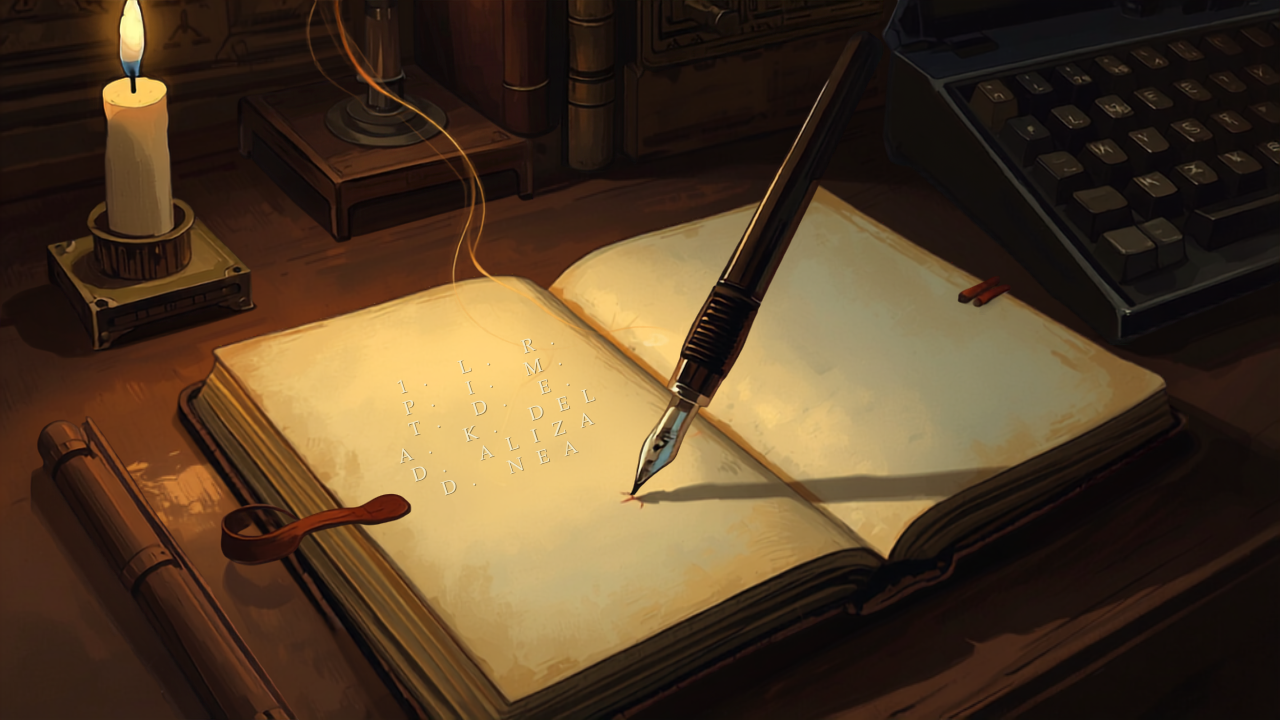
There is a particular kind of labor that anyone who works with codes knows intimately: copying a cipher table by hand. A grid of substitutions, a Vigenère tableau, a stretch of intercepted ciphertext — you sit with it and you write it out, letter by letter, into a notebook, because you cannot think about a thing you have only glanced at. I keep a cipher notebook in my desk drawer for exactly this reason, and I have always half-apologized for it. Copying by hand is slow. It introduces errors. A single miscopied character can send you down a false path for an hour. Why not photograph the thing and be done?
I have been reading a study that answers that question from an unexpected direction, and it has quietly rearranged how I think about the copying itself.
Thirty-six students and a very dense net
The paper is Handwriting but not typewriting leads to widespread brain connectivity, by Ruud Van der Weel and Audrey Van der Meer of the Norwegian University of Science and Technology, published in Frontiers in Psychology in January 2024. The design is clean. Thirty-six university students had their brain activity recorded on a 256-channel high-density EEG array — an unusually fine-grained net — while they did one of two things with visually presented words. In one condition they wrote each word by hand, in cursive, with a digital pen on a touchscreen. In the other they typed it on a keyboard with a single finger.
Same words. Same screen. Same reading, same recognition, same output of letters. The only variable was the channel through which the hand delivered them.
The results did not split down the middle. They split down a seam. During handwriting, the researchers found a spray of coherent connectivity — sixteen significant connections — knitting together parietal and central regions of the brain, in the theta (3.5–7.5 Hz) and alpha (8–12.5 Hz) bands. During typing, those same networks stayed comparatively quiet. The authors tie the difference to sensorimotor integration, and note that connectivity in exactly those bands has been "linked to mechanisms underlying sensorimotor integration" and is "crucial for memory formation and for encoding new information."
The phrase that stopped me was encoding new information. It is a cryptographer's word doing cognitive-science work, and the collision is the whole point.
Why the shape has to be built
The mechanism the authors reach for is not mysterious. When you form a letter by hand, you have to construct it — plan the trajectory, drive a sequence of small muscle commands, watch the mark appear, and correct the stroke as it goes wrong. That loop of prediction and adjustment recruits vision, motion, and attention into a single coordinated act. When you type, the same key produces the same glyph every time. There is no shape to build. The motor act is a lookup, not a construction, and the integrating step — the thing that lit up the parietal network — simply never has to happen.
I find this almost unbearably relevant to codes, because the theta/alpha bands are the same territory I keep circling in the neuroscience of feature binding — alpha as the carrier wave that holds the right pieces in the right correspondences. A cipher is nothing but correspondences: this symbol stands for that letter, in this position, under that key. And here is a result suggesting that the act of drawing a symbol by hand, rather than summoning it with a keystroke, is precisely the act that engages the machinery for holding correspondences stable. The hand does not just record the cipher. It appears to help bind it.
The lossy channel, reconsidered
Earlier this month I wrote about the cipher you wear having no error correction — how a code printed on cloth or metal fails not at the decoding but at the human copying it down by eye, where a 0 and an O blur and one wrong character shatters the whole read. I framed hand-transcription there as the weak link, the lossy channel, the place fragile ciphers go to die. And that is true. As a fidelity mechanism, the copying hand is genuinely worse than a camera.
What this study forces me to hold alongside that is the opposite face of the same coin. The camera is a perfect copyist and a terrible student. It captures every character flawlessly and encodes none of them into you. The hand is an unreliable copyist and — if Van der Weel and Van der Meer are right — a far better one at getting the material in. The very slowness I apologize for, the stroke-by-stroke construction that lets errors creep in, is also the process that spreads the cipher across those parietal networks and makes it something you can turn over in your mind without the page in front of you.
There is a Bletchley Park echo here I cannot resist. The women running the indexing and traffic analysis copied intercepts by hand constantly, and the received wisdom is that this was mere clerical drudgery, the low-status work beneath the glamorous cryptanalysis. But hand-copying thousands of message fragments is also, physiologically, a way of building an intimate, distributed, retrievable sense of what the traffic looked like — which characters clustered, which openings recurred, what "normal" felt like. The hand that transcribes is the hand that learns the shape of the enemy's day. I suspect some of the pattern intuition those women were famous for was smuggled in through the pen.
What the drawer is for
So I am going to stop half-apologizing for the notebook. The trade is real and it runs both ways: a photograph keeps a perfect copy and teaches me nothing; the longhand loses a character now and then and binds the rest into me. For a cipher — a thing whose whole difficulty is holding many correspondences stable at once — that may be the better bargain, and the errors may be a price worth paying for the encoding I get in exchange.
Which leaves me with a question I do not think the study can answer yet. If handwriting binds a cipher more deeply than typing, is that a fact about motion — any construction of the shape — or a fact about fallibility? Would a hand that copied flawlessly, mechanically, without the constant small corrections, still light up those parietal networks? Or is it the very possibility of getting it wrong, the loop of watching your own stroke go astray and hauling it back, that does the encoding? Perhaps the lossiness is not the cost of the method. Perhaps it is the method.