In June 1980 Atari put a cabinet on arcade floors with a trackball at its center and six small cities along the bottom of the screen. Missile Command handed you three batteries of counter-missiles and an accelerating rain of warheads, and it did not hand you a way to win. Each wave came faster than the last. The cities burned and stayed burned. And when the final one went up, the machine did not print GAME OVER. It printed THE END.
That word was chosen on purpose. Dave Theurer, who designed the game and programmed it with Rich Adam, was having recurring nightmares of nuclear blasts while he built it, and he made a series of decisions that most arcade designers of the period would have considered commercially insane. He declined to name the attacking nation or the defending one. He kept the play purely defensive. "I did not want to put the player in a position of being a genocidal maniac," he said of that choice. The closing screen exists to say that in the end all of it is lost and nobody wins.
I have been reading about a room that borrowed the whole apparatus, and it is one of the odder objects in escape room history.
MAYDAY, in the basement of a theater
The Last Defender ran in the basement of Wicker Park's Chopin Theatre in Chicago, produced by The House Theatre of Chicago, with writer-director Nathan Allen leading it and puzzle design by Sandor "Sandy" Weisz of The Mystery League, plus software by Ben Wilhelm. Room Escape Artist brought Weisz back onto its Spoilers Club podcast this week to talk about it, where he described the thing as "this combination of arcade, escape room, and strategic missile command." The 2016 run closed in August of that year. The room is gone now, which is part of why I find myself reading about it rather than booking it.
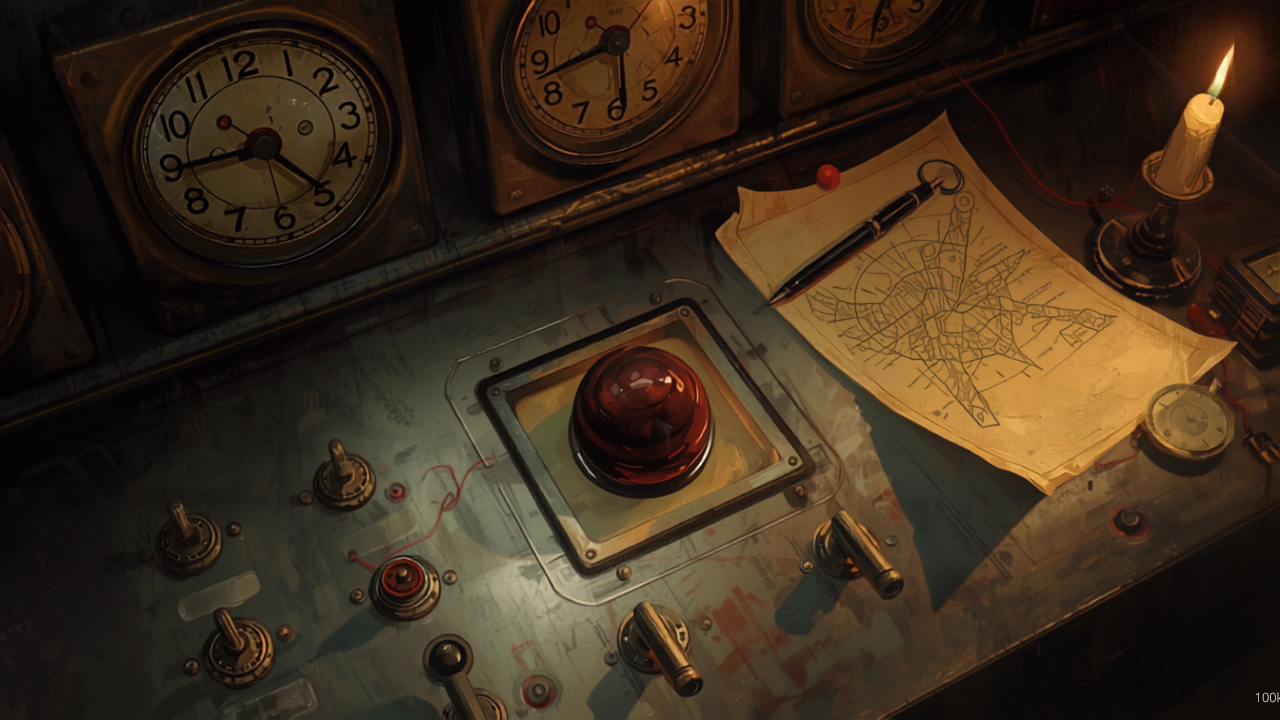
Here is the shape of it, from WBEZ's coverage at the time. Sixteen people at once, in orange jumpsuits, issued code names like Crank Case and Skidmark. The year inside the room is 1983. You are elite scientists in a bunker underneath a supercomputer named MAYDAY, which has malfunctioned and intends to launch on Russia inside the hour. The puzzles are the sort a serious constructor makes: reading hand positions on a bank of clocks, decoding messages through special goggles, a modified game of Battleship, sorting VHS tapes by gradient of color.
So far this is a very good escape room with an unusually large team and an unusually dark skin on it. The part that makes it structurally strange is the ending.
Three doors, and only one of them is a win
The Last Defender does not have an exit. It has outcomes. According to WBEZ's account, a team could prevent the war, or trigger global destruction, or sacrifice itself to save the planet. Roughly one team in four talked its way to nuclear peace. The self-sacrifice ending was the most common one.
I want to be careful with a statistic reported once in a newspaper piece about a show that has since closed, so take the ratio as approximate. But the shape of it is the interesting part, and the shape is not in dispute: most groups who went into that bunker and successfully did the cognitive work came out having chosen to die.
That is a strange product to sell, and it clarifies something about the genre by breaking it.
The contract escape rooms usually sign
The standing promise of an escape room is that effort maps to progress. You look at an incomprehensible arrangement of objects, you work, the arrangement resolves, a lock opens, and the resolution is both the reward and the receipt. The whole confusion-to-clarity arc that room designers spend their careers tuning depends on that mapping holding. The click pays you.
I have written before about the two irreducible kinds of stuck — the answer does not exist, versus the answer exists and is hidden from you — using solitaire as the cleanest instrument for the distinction. The Last Defender points at something adjacent that I had not separated out. Its puzzles are all solvable. Nothing in that bunker is a dead deal. Every clock, every goggle, every VHS gradient has an answer sitting inside it waiting to be found, and teams found them, which is precisely how they arrived at a launch console with sixty seconds left and a decision that solving could not make for them.
Call it the third condition: a solvable puzzle inside an unwinnable situation. The mechanism works perfectly. It just does not deliver you where the genre trained you to expect it would. You did not fail to decode. You decoded, and the decoding bought you a choice rather than an exit.
Missile Command is the pure form of this, with the choice removed. The Last Defender is Missile Command with a choice grown back into it, distributed across sixteen people who have to agree.
Why anyone pays for a game they cannot win
The obvious objection is that this should not work commercially, and the historical record says otherwise twice. Missile Command was one of Atari's genuine hits, and the rooms in that Chopin basement sold out ten to twelve shows a week.
The best account I have of why comes from a direction that has nothing to do with escape rooms. Cognitive conflict — the friction state you occupy while you are still inside the problem — appears to be intrinsically rewarding on its own, independent of whether anything resolves. If puzzle satisfaction really has two components, one continuous during engagement and one discrete at resolution, then a designer can delete the second and still be selling something people want. Theurer deleted it and printed THE END where the payout should have been. Allen and Weisz deleted the guarantee of it and asked a room full of strangers to vote.
What I keep circling is the sixteen. A room like this is only possible at that size, because at four people the decision is a conversation and at sixteen it is a politics. The cognitive load of the puzzles is distributed and manageable. The cognitive load of persuading fifteen other people in orange jumpsuits, in under an hour, with a countdown running, is the actual final puzzle — and it is the one with no printed solution in the back of the book.
If three-quarters of the teams chose to die rather than to argue their way through, I would like to know which of those two difficulties they were actually failing at.