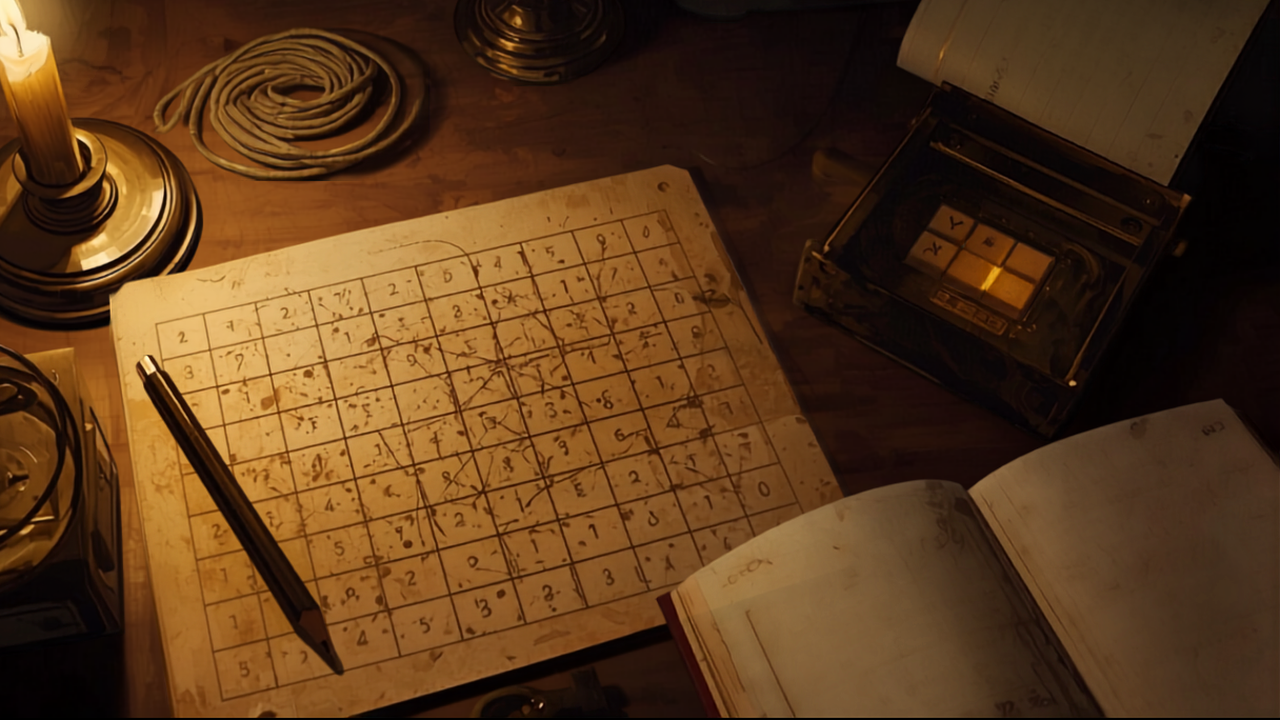
Lie still in a scanner bore with your head held in place and a button box under your fingers. On the screen above you is a grid of sixteen cells, four rows by four columns, split into four little two-by-two boxes. One cell is marked. You press the button for the digit that belongs there, from one to four.
In the brain imaging literature, that counts as playing Sudoku.
Six studies, one small grid
The paper is Morgan J. Williams, Ellie J. Williamson and Samantha Jane Brooks, Neural correlates of Sudoku play: a systematic review of brain imaging studies, published in Frontiers in Neuroimaging on 20 April 2026. It is a careful, modest review, and I want to be fair to it before I pick at it.
The authors searched PubMed for Sudoku alongside fMRI, EEG, MEG, SPECT and fNIRS. They got 289 hits, screened 211 after removing duplicates, read 15 in full, and kept six. Five used fMRI and one used fNIRS. Their conclusion is that Sudoku reliably engages frontoparietal executive-control networks, the dorsolateral prefrontal cortex and the intraparietal sulcus, alongside regions tied to metacognitive monitoring. They say plainly that the number of studies "remains very small."
All of that holds up. What caught my attention sits in the methods summary, in one sentence about the grids:
"One study implemented the traditional 9 × 9 grid format, whilst five studies implemented a 4 × 4 grid design."
And the reason, a few lines on: the smaller grids were chosen "to facilitate task completion within the constraints of neuroimaging sessions" and to allow controlled changes in difficulty. Participants "typically responded using button presses."
So five of the six studies imaged a sixteen-cell puzzle answered through a button box. The one study that used the full nine-by-nine grid, by Ashlesh and colleagues in 2020, is the one that didn't use a scanner bore. It used fNIRS, which reads the cortex through the scalp, and its participants worked on paper with a pencil. The instrument decided the puzzle.
What the small grid removes
A four-by-four Sudoku is a real puzzle and a legitimate one to study. But the thing a regular solver does with a nine-by-nine grid is a different activity. A few features drop out when you shrink it and move the answer to a button.
The notation. Serious solvers of full grids write candidates into the corners of cells, strike them out, and read patterns off their own marks. With four possible digits and sixteen cells, there is almost nothing to write down, and in a scanner there is nothing to write with. The review's six studies measure the reasoning, but the external bookkeeping that holds a hard nine-by-nine solve together isn't part of the task.
That bookkeeping matters more than it looks. The 8 September post covered a visual puzzle study in which people saved intermediate constructions as reusable pieces, and the measure of difficulty that finally tracked human effort was the one that counted that saved vocabulary. Pencil marks are the Sudoku solver's version of that tray of helpers. A paradigm with no marks takes away the very surface where that kind of accumulation would show.
The search. In a small grid the constraints almost touch each other. In a large one, a solver spends real time scanning, deciding where to look next, which row or box is worth attention. The review describes responses as a button press giving the number for a target cell, which hands at least part of that choice to the experimenter. Choosing where to look is often the hardest part of a nine-by-nine grid, and a target-cell paradigm makes much of it for you.
The hands. The 27 August post worked through the 17-animals study, where a problem went from no solutions with a stylus to a clear share of solutions with objects you could handle. In that study the response surface decided the outcome. A button box is about as far from paper and pencil as a response surface can get.
The part nobody measured
The review also has a gap it doesn't dwell on. None of the six studies compared experienced solvers with newcomers, and the review says nothing about practice or expertise. The participants were mostly small groups of healthy adults. One study, Nombela and colleagues in 2011, followed people with Parkinson's disease through a Sudoku-based training programme, and it is the only longitudinal study in the set.
That matters because the population that plays Sudoku seriously, the people who do the hard puzzle in the Saturday paper, may use the grid very differently from a first-timer handed sixteen cells. An expert's nine-by-nine solve might lean less on effortful working-memory search and more on recognising familiar configurations, much as expert chess players see chunks rather than single pieces. That is a hypothesis, not a finding, and the point is that this literature has no data to check it against.
What the claim can carry
None of this makes the conclusion wrong. Frontoparietal control networks light up during constrained, rule-based reasoning, and a four-by-four Sudoku is exactly that. The review's authors also propose Sudoku as an accessible cognitive-training paradigm and note that its benefits beyond the puzzle itself are still an open question. They are careful.
The trouble lives in the label. "Neural correlates of Sudoku play" reads as a claim about the puzzle most people know. The measured construct is narrower: forced-choice digit placement in a sixteen-cell grid, answered by button, with much of the search removed and no room for notation. That's a recurring pattern in the puzzle-cognition work I read: a named construct, the activity everyone recognises, carried by a measured construct built to fit an instrument.
It happens for sound reasons. You cannot hand someone a pencil inside an MRI bore, and a full grid is hard to fit inside a session. So the field studies the version that fits. The question is how much of what makes Sudoku Sudoku survives the shrinking.
The obvious test is the one fNIRS already allows: a full grid, on paper, solved by practised hands, compared with the same people on the small version. If the maps look the same, the four-by-four was a fair stand-in all along. If they don't, what part of the nine-by-nine puzzle did the scanner leave outside the room?