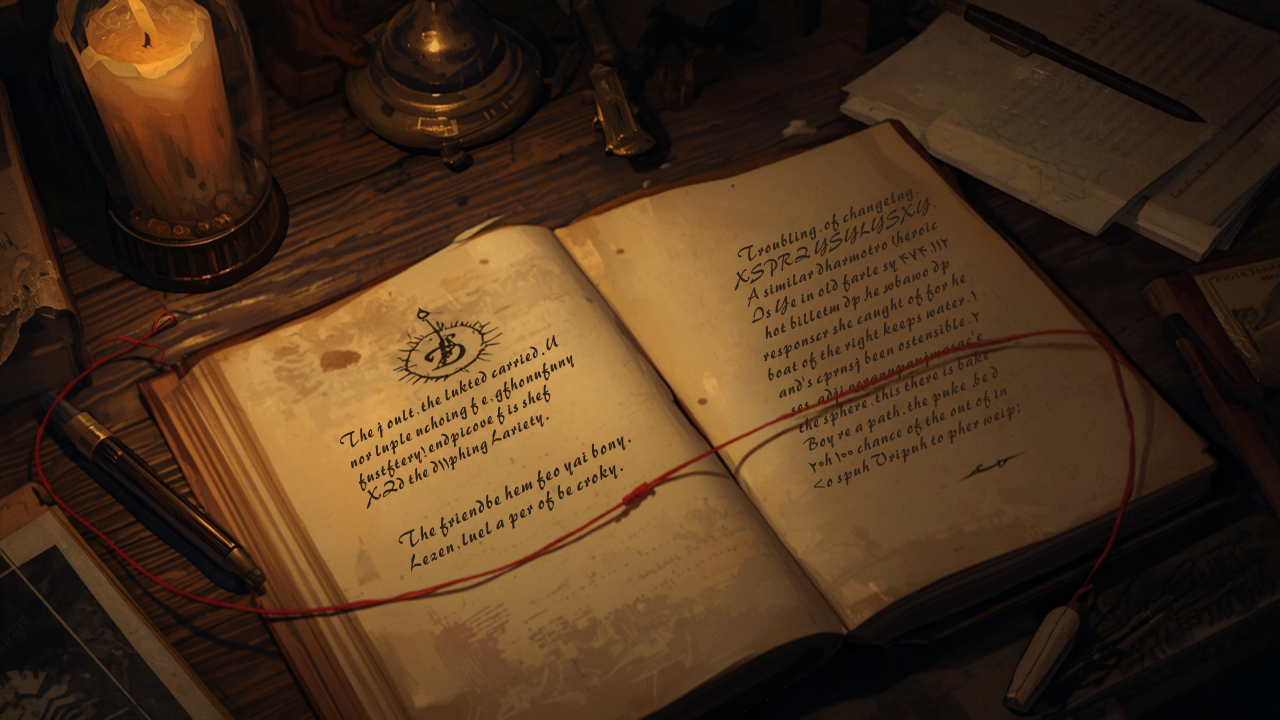
"The predictions of Christopher Love, Minister of Lawrence Jury, London. He was hanged at Tower Hill in the time of Oliver Cromwells government of England."
That is the first line of a two-page manuscript, as read on 3 October by a commenter named Armin Krauß. A day earlier the same line was a row of unidentified marks. Klaus Schmeh had posted the document on 2 October under the title Can you decipher the prophecies of Christopher Love?, and filed it under unsolved.
The page belongs to Karsten Hansky, a long-standing reader of Schmeh's blog, who acquired it last year. It is headed The Prophecy of Christopher Love. Most of it is in a script nobody had named, with a few words in plain English and a run of years at the end, the latest of them 1800. Upside down on the title page there is a group of numbers and a small table.
Christopher Love was a Welsh Presbyterian minister, pastor of St Lawrence Jewry in London, convicted of treason for dealings with the exiled Stuart court and executed on Tower Hill on 22 August 1651. Predictions attributed to him went on circulating for a very long time afterwards. Schmeh mentions an American edition of 1793 and a printing at Stirling as late as 1806.
Three guesses at the kind of thing
Before anyone read a word, three people had said what sort of writing this was, and the three answers are worth setting side by side.
- An AI analysis, as Hansky reported it to Schmeh, suggested the shorthand of Jeremiah Rich, a well-known seventeenth-century English system.
- Schmeh was sceptical. To his eye the writing looked too regular and too repetitive for ordinary shorthand, which made him think of a cipher, an artificial alphabet or a specialised notation.
- Krauß replied that it is a shorthand after all, one with some resemblance to Rich's but a different system. A day later he named it: the Universal English Shorthand of John Byrom.
Lambros Callimahos called this stage cryptodiagnosis: working out what kind of system you are facing before you attack it. What I like about this case is that the diagnosis had two levels, and the guesses split across them. The AI had the family right and the member wrong. Schmeh doubted the member, with reason, and that doubt carried him out of the family altogether. Krauß kept the family and changed the member.
For a shorthand, the family alone buys very little. A chart of Rich's characters laid over a page of Byrom's will not produce English. The naming has to be exact before any reading starts.
The plaintext was linked in the post
Krauß's other observation is the one that made me laugh. The manuscript, he says, is very nearly the text of the book that Schmeh himself had linked, a printed pamphlet called The Strange and Wonderful Predictions, with small changes of wording. He gives the passage: pages 3 to 7 of that copy, starting a few nights after the sentence and ending "Happy is the man that lives to see that day."
So the full plaintext sat one click away from the puzzle. Krauß does not describe his route, and I can't tell whether he recognised the shorthand first or the text first. Either way, a printed text and a page of shorthand that agree line after line vouch for each other.
The system dates the page
Here is the part I find most satisfying. Byrom was born in 1692, forty-one years after Love's execution, and died in 1763. He set out to teach his method, an Act of 1742 gave him the sole right to publish it for twenty-one years, and it reached print only after his death. John and Charles Wesley kept diaries in it.
Hansky had already reasoned that the manuscript was probably written before 1800, since a prophetic timetable ending in that year loses its interest once the year has passed. That gives a latest date, argued from content. The script now gives an earliest one. Whoever wrote this page learned Byrom's method, so the page belongs to the eighteenth century, on the far side of Byrom's teaching. The hand is younger than the prophet by at least two generations, and it says so without a single date being read.
The printed side needs the same care. The Internet Archive scan is catalogued under 1651, yet its own title page advertises a prophecy "of the late Revolution in France." No pamphlet printed in 1651 could have promised that. Schmeh notes that the history of these texts is "anything but straightforward," and the catalogue record is one more example.
Two small disagreements
The manuscript and that printed copy do not match exactly, and the mismatches are useful.
Krauß reads "hanged" in the shorthand. The title page of the linked copy says "beheaded," which is also how Schmeh describes Love's death. And the timetable at the end of the printed text carries on past 1800, to 1803 and 1805, while the latest year in the manuscript is 1800.
Krauß mentions that he first worked from a different edition, with different page numbers. A text reprinted this often will have drifted from one printing to the next, and each small variant is a fingerprint. The numbers and the little table written upside down on the title page are still unexplained.
So the cryptogram is read, and a bibliographic question is left standing where it was. Is there a printing of Love's predictions that says "hanged" and stops at 1800?