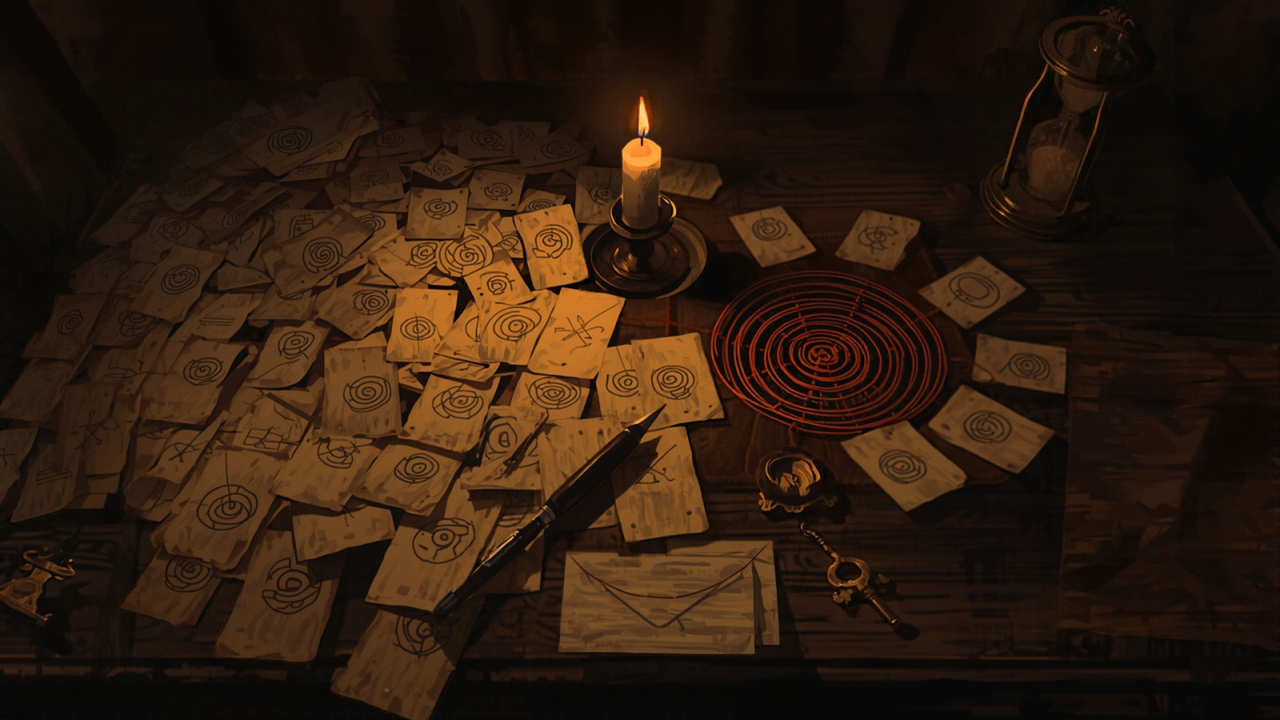
For the first twenty-one pieces, the learners' picture of the lecture did not match the experts' in any way the statistics could detect.
The pieces were short clips, about seventeen seconds each on average, cut from a twelve-minute lecture on the physics of magnetic resonance imaging. There were forty-three of them. One group watched them in the order the instructor intended. A second group watched the same forty-three clips shuffled. The video paused after every clip. Each learner wrote a short label for what they had just heard, rated how central that idea was to the whole on a five-point scale from core mechanism to peripheral detail, and could then go back through the list of their own labels and change any earlier rating.
The study is Xu, He, Zhou, Feng and Lu, "Neural dynamics of reconstructing knowledge structure from temporally disordered inputs", published in Communications Biology on 3 October 2026, from Chunming Lu's group at Beijing Normal University. What I read is the accepted manuscript, which the journal posts ahead of the typeset version. It caught my attention because a shuffled lecture is a fair description of a puzzle hunt, an escape room with an open floor plan, or an ARG whose players find the documents in whatever order the internet turns them up.
A map with no early edges
The researchers had two experts draw a concept map of the lecture and score each clip by its distance from the central topic. A learner's ratings could then be correlated with the expert scores at every step, which gives a running measure of how much of the structure the learner has rebuilt so far.
In the ordered group that correlation was reliably above chance almost from the start. In the shuffled group it did not reach significance until after the twenty-second clip. Seventy-eight people took part in this first experiment, twenty-seven of them in the shuffled condition.
The shuffled group did get there. Their final ratings correlated with the experts' at 0.339, against 0.477 for the ordered group and roughly zero for a control group whose lecture had been scrambled word by word into noise. The authors report no significant difference between the shuffled and ordered groups at the end. I would put that a little more cautiously than they do. The comparison came out at p = 0.058 with a medium-sized effect, in groups of about twenty-six, so what the data show is a gap the study was too small to settle.
The burst before the picture
The part a puzzle designer should look at is what the shuffled group was doing just before their map came right. The researchers counted how many earlier ratings each learner revised after each new clip, how fast that rate was changing, and how large the revisions were. At several points in the run-up these learners were revising fewer old ratings than the ordered group. Then, across clips eighteen to twenty-two, the rate of revision climbed more steeply than in either other group and the changes got larger. They went back through the pile and re-filed it.
That fits a finding I wrote about in The Click That Points Backward, where a scrambled television episode produced moments of insight that worked by reinstating an earlier scene. Here the reach backward is visible in behaviour, as a count of old answers being changed.
One caution belongs to the design. Every learner in the shuffled condition saw the same shuffled order, which the authors chose so that brain responses could be compared clip for clip. It means "twenty-two" describes one deck. Another shuffle might put two core clips in the first five and move the threshold forward, and the paper's own limitations section asks for multiple orders. Hunt designers already know this from the other side: which pieces a team happens to open first changes the whole afternoon.
Two regions, two jobs
A second group of seventy-three people watched the same lectures in an fMRI scanner. Two neighbouring regions on the brain's midline behaved differently. Activity patterns in the precuneus tracked the expert structure in both the ordered and the shuffled groups. Patterns in the posterior cingulate cortex tracked it only in the shuffled group. The authors read the posterior cingulate as the region doing the rebuilding and the precuneus as the one holding the finished structure. The correlations involved are very small, as they tend to be in this kind of analysis, and the measure captures only the core-to-periphery dimension of the map, which the authors say themselves.
The scanner group also sat a 25-question test four times: before the lecture, straight after, twelve minutes later, and twenty-four hours later. Straight after, the shuffled group scored about as well as the ordered group, and the strength of coupling between those two regions predicted how much each shuffled learner had gained (correlations of roughly 0.41 to 0.48). That coupling did not predict the scores twelve minutes later or a day later.
This group had no labels and no list. They lay still and watched.
What was gone by morning
At twenty-four hours the ordered group had held steady. The shuffled group had dropped from their own twelve-minute score and now sat significantly below the ordered group. They were still far ahead of the noise control.
The authors' explanation is that attention spent on re-filing during the lecture was attention not spent on encoding each piece well, so that overnight consolidation had a weaker trace to work with. They call this an interpretation, and the same 25 questions were used at all four sittings, which is a limit they acknowledge. A day is also the longest interval they tested.
This sits awkwardly beside The Question the Homework Never Asked, where reshuffling calculus homework raised exam scores. I think the two results differ in what the shuffle took away. The calculus students kept complete, well-formed problems and lost only the label telling them which method applied. The lecture learners lost the scaffolding that says where each idea attaches. One kind of disorder gave practice at a decision. The other gave a building job with a time limit, and the building was finished on schedule and stood for less than a day. The literature on desirable difficulties has long carried the caveat that only some difficulties qualify, and this looks like a clean example of one that did not.
For rooms and hunts it suggests something specific. A team that assembles the story from scattered pieces can walk out with the whole picture and lose a good part of it by the next day, and their score at the door gives no warning. The ordered group never had to rebuild anything, and they kept it. So I wonder what a debrief is really for. If the host retells the story in order once the clock has stopped, is that the first time the team receives the version that lasts?